

Cybersecurity / Penetration testing
Penetration Testing
Safe, authorized testing that proves which weaknesses an attacker could actually reach — with evidence and a prioritized fix order.
Tampa headquarters · Customers nationwide
What we test, and how
Find the paths an attacker would actually take.
We start where an attacker starts — the internet, a stolen credential, an overlooked remote access path — and stop only when we can show exactly how far each route leads.
Assessments tell you what might be wrong. Penetration testing tells you what an attacker could actually reach. We run safe, authorized tests that follow the same routes a real adversary would, toward the systems that matter most.
Every test runs inside an agreed scope and rules of engagement, is designed to be non-destructive, and can be paused on request. Findings include the evidence: what was tried, what worked, and how far it led. Nothing is presented as a theoretical risk without proof.
You get a remediation order you can defend to a board or an insurer — the paths that lead to real exposure first, then the controls that reduce the rest — followed by re-testing to confirm the gaps closed.
Prove it before someone else does.
Each engagement starts where an attacker starts and stops only when the real limits of your environment are clear.
- 1Step 01 — Scope
Systems, accounts, and rules of engagement are agreed in writing before anything is touched.
- 2Step 02 — Simulate
Autonomous attacks run from the internet and from the position a compromised account would have.
- 3Step 03 — Validate
Each path is followed to proof: what was reachable, and how far it led.
- 4Step 04 — Prioritize
Findings are ordered by real exposure, not by severity labels alone.
- 5Step 05 — Verify
After remediation, the same paths are re-tested to confirm they closed.
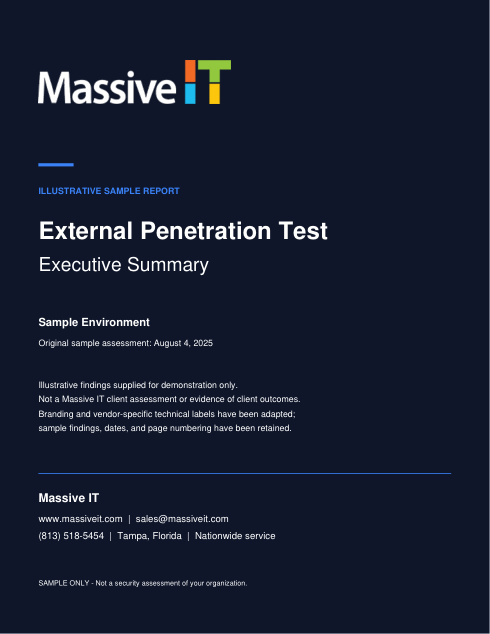
Sample deliverables
Penetration testing reports
Illustrative sample reports—not actual Massive IT client results. Sample findings and assessment dates are retained; branding and vendor-specific technical labels have been adapted.
Executive Summary
Exposure overview, business impacts, top weaknesses, and systemic recommendations.
PDF · 6 pages
Penetration Test Report
Detailed findings, attack paths, affected assets, technical evidence, and assessment appendices.
PDF · 137 pages
Fix Action Report
Severity-ordered remediation guidance and reference material for your technical team.
PDF · 77 pages
What the assessment covers
Evidence you can act on.
Findings arrive with proof, context, and a defensible order for fixing them — not a stack of possible issues.
External attack surface testing
Internal network and lateral movement testing
Adversary simulation from real starting positions
Proof of exploitability with documented evidence
Prioritized remediation guidance
Re-testing to confirm fixes

Where the risk sits
Attacks succeed on the basics that never got done.
- Vulnerability scans that list issues without showing real risk
- Pressure from insurers, clients, and regulators to show testing
- Uncertainty about which weaknesses actually matter
- Limited time to work through long remediation lists
What a stronger posture looks like
- Evidence of what an attacker could actually reach
- A defensible remediation order
- Confirmation that fixes closed the gaps
- Reports that support insurance and audit requests